
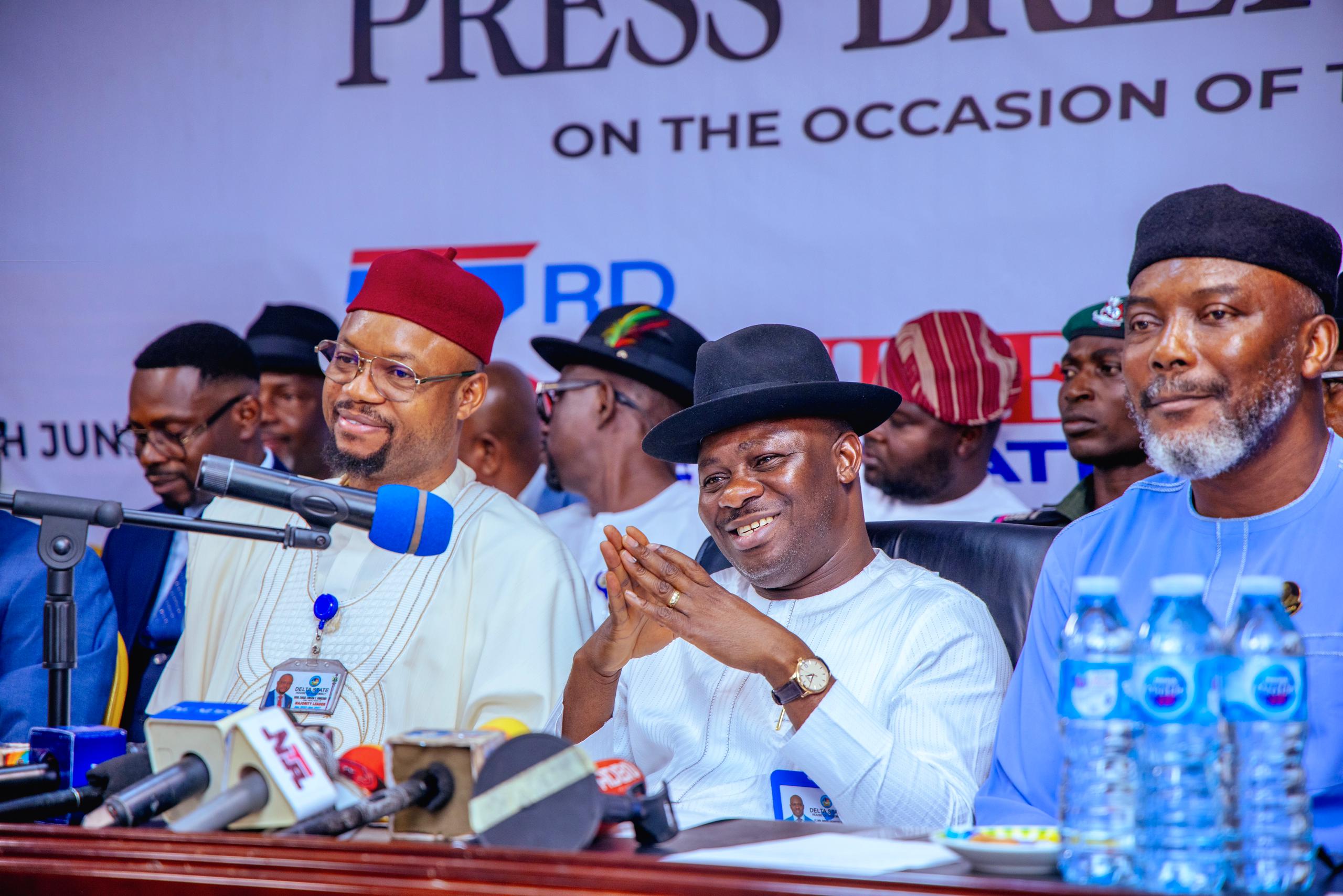
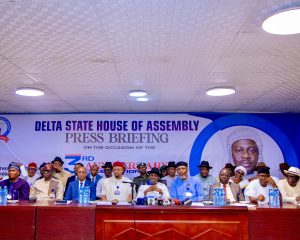
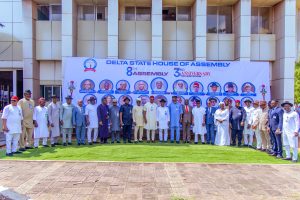
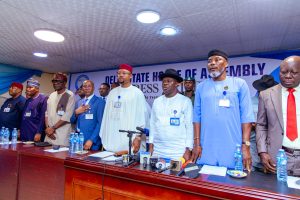
Speaker of the Delta State House of Assembly, Rt. Hon. Emomotimi Dennis Guwor, Thursday, rendered account of the 8th Assembly’s performance as it clocks 3 years, citing legislative productivity, infrastructure oversight, and institutional reforms as key achievements since inauguration on 13 June, 2023.
Speaking at a well attended press briefing in Asaba, Rt Hon Guwor said the House has “remained committed to our constitutional responsibilities of lawmaking, oversight, representation, and partnership in governance for the overall development of our dear State”.
For the Third Session under review, the Speaker disclosed that the House received 11 Bills, including 5 Executive Bills and 6 Private Members’ Bills. Five have been passed. Four have received Governor Sheriff Oborevwori’s assent, while one is being processed for assent.
Those assented to include, Appropriation (Amendment) Bill, 2024, Delta State Anti-Terrorism and Anti-Cultism (Amendment) Bill, 2025, Delta State Appropriation Bill, 2026, and Supplementary Appropriation Bill, 2025.
Bills currently undergoing consideration include, the Delta State Gaming Board Bill, 2025, Landlord and Tenant Bill, 2025, Violence Against Persons (Amendment) Bill, 2025, HIV/AIDS Hepatitis B/C Anti-Discrimination Bill, 2025, Cybercrime Prohibition Bill, 2025, and Public Health and Hygiene Bill, 2025.
According to the Speaker, a major legislative milestone was the Delta State Revenue Service Bill, 2026, which he said was passed and is “currently being processed for assent.
“The overarching objective of the Bill is to harmonise and improve revenue generation in the State, eliminate multiple taxation, and create a more business-friendly environment that will enhance ease of doing business and attract investment”, Guwor explained.
Demonstrating support for infrastructural development, the House approved the 2026 Appropriation Law at N1.729 trillion against the N1.664 trillion initially presented by Governor Sheriff Oborevwori.
Guwor said the intervention was “aimed at providing additional resources for critical projects and programmes that directly impact the lives of Deltans”.
The Speaker stressed that the 8th Assembly maintained “a cordial, productive, and mutually respectful relationship with the Executive arm of government, while maintaining the sanctity of the doctrine of separation of powers and non-interference”.
He credited the synergy for the “successful implementation of the administration’s M.O.R.E Agenda, resulting in remarkable infrastructural development across the State”.
Citing visible results, he noted: “Today, Deltans can attest to the completed and ongoing construction of major flyovers in Uvwie, Warri, Ughelli, and Agbor. Equally noteworthy are the unprecedented road networks connecting rural communities to urban centres, the provision of healthcare facilities and quality healthcare services, and the sustained development of our riverine communities”.
Beyond Bills, the House during the period under review, screened and confirmed nominees for the Delta State Civil Service Commission, Structure for Signage and Advertisement Agency, and Judicial Service Commission.
It also considered and approved audit reports, including, the Auditor-General (State) report on Delta State Government accounts for year ended Dec 31, 2024; DESOPADEC accounts for same period; and the Auditor-General (Local Governments) report covering all 25 LG Councils for 2024.
In what Mr Speaker called “legislative innovation”, the House established the *Post-Legislative Scrutiny Department* in partnership with the Westminster Foundation for Democracy, WFD, UK.
“Delta State is the second State in Nigeria, after Oyo State, to establish a Post-Legislative Scrutiny Department. The Department will “systematically monitor and evaluate the implementation and effectiveness of laws passed by the House, assess their impact on the daily realities of our people, and recommend legislative interventions where necessary”, Guwor added.
To preserving legislative heritage, the Speaker said the Assembly hosted a reunion of sitting and non-sitting members on November 14, 2025, the first since the House’s inception in 1992.
“The gathering provided a platform for interaction, exchange of ideas, promotion of unity, preservation of institutional memory, and collective commitment to the peace, stability, and development of Delta State”, Guwor noted.
On leadership beyond Delta State, Rt Hon Guwor stressed that the 8th Assembly’s profile rose nationally during the period. He disclosed that he was “unanimously elected Chairman of the Conference of Speakers of State Legislatures of Nigeria.
The Deputy Speaker emerged Chairman of the Forum of Deputy Speakers, while the Leader of the House became Chairman of the Nigeria Majority Leaders’ Forum.
“This unprecedented achievement has elevated the profile and visibility of the Delta State House of Assembly at the national level,” Guwor stated.
According to Mr Speaker, the House prioritized staff welfare through training, sponsorship to professional conferences, and implementation of the “Consolidated Legislative Salary Structure, CONLESS”, by the State Government.
“Of particular significance is the implementation of CONLESS for staff of the House and the Assembly Service Commission. This enhanced and specialised remuneration structure has greatly improved staff welfare and morale,” he said.
Guwor explained that work is also progressing on a dual-purpose complex to house the Assembly Service Commission and the Assembly Clinic.
While reassuring Deltans of commitment to people-oriented legislation, Speaker Guwor expressed gratitude to Governor Sheriff Oborevwori for “healthy synergy,” his colleagues for “unwavering support,” and staff and media for professionalism and visibility.
“As we celebrate the Third Anniversary of the 8th Assembly, the House remains committed to enacting people-oriented legislation, strengthening oversight functions, promoting transparency and accountability, and supporting policies and programmes that will advance the growth, peace, and prosperity of Delta State,” the Speaker concluded.