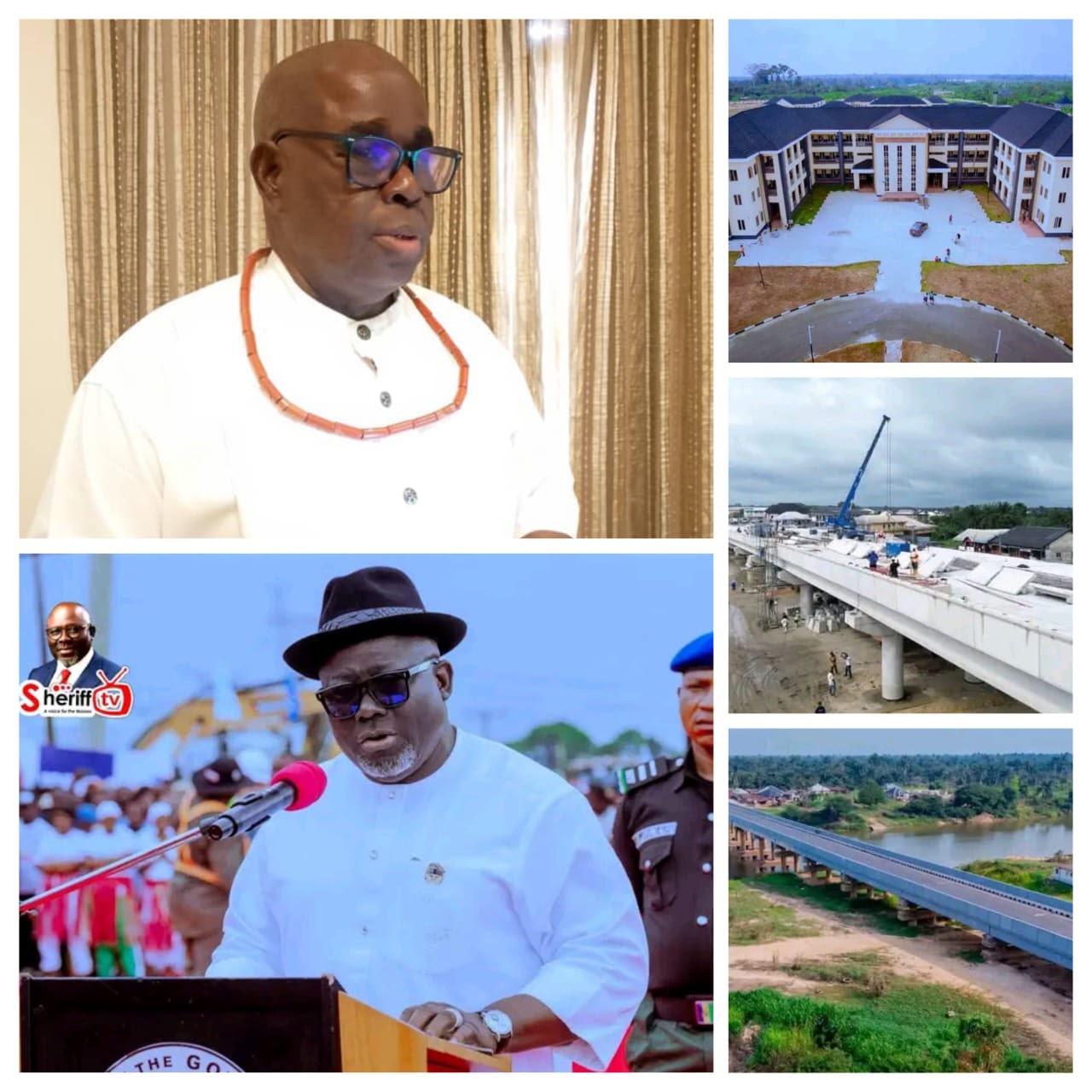
By Chief Anthony O. Akpomiemie, Esq.
As Delta State moves towards another governorship election, the question Deltans should be asking is not simply who is making the most noise or who has the most impressive political slogans. The more important question is: what has the present administration done, what challenges remain, and who is best placed to take the state forward?
For me, Governor Sheriff Oborevwori deserves the opportunity to serve a second term.
I say this as someone who believes that political support should not mean refusing to acknowledge the shortcomings of government. No administration is perfect, and Governor Oborevwori’s government is no exception. There is still much work to be done across Delta State.
But when we look at the administration’s record since the governor assumed office on May 29, 2023, I believe there is a reasonable and compelling case for continuity.
A governor who understands government
Governor Oborevwori did not come into Government House as a political novice.
Before becoming governor, he represented Okpe Constituency in the Delta State House of Assembly and rose to become Speaker. He served as Speaker from May 11, 2017, until he became governor in 2023.
That experience is important.
Governance is not only about making promises. It involves understanding the machinery of government, working with the legislature, managing competing interests and building relationships across political and community lines.
Having spent many years in the legislature, Governor Oborevwori came into office with a good understanding of how government works and the realities of representing different interests.
The MORE Agenda
At the centre of the governor’s administration is the MORE Agenda — Meaningful Development, Opportunities for All, Realistic Reforms and Enhanced Peace and Security.
Of course, an agenda is only as good as its implementation. Deltans should therefore judge the administration by what has actually been delivered rather than by slogans.
And this is where the discussion becomes important.
There are projects and programmes across the state that provide evidence that the administration is trying to translate its promises into reality.
Infrastructure that people can see
Perhaps the most visible area in which any government can be judged is infrastructure.
Since 2023, the Oborevwori administration has continued with road construction, rehabilitation and other infrastructure projects across Delta State. There have also been major interventions around Warri, Effurun, Ughelli, Asaba, Agbor and other parts of the state.
Some of these projects involve roads, bridges, flyovers and other facilities designed to improve movement and reduce the difficulties faced by residents.
We should not underestimate the importance of such projects.
A good road is more than asphalt and concrete. It can determine whether a farmer gets his produce to market on time. It can affect the cost of transporting goods. It can make it easier for children to get to school and workers to get to their places of employment.
For the person who uses the road every day, development is not an abstract concept. It is something that should make life a little easier.
This is why I believe the governor’s infrastructure record deserves recognition, while the government should also be encouraged to ensure that ongoing projects are completed to the required standards.
Empowering ordinary Deltans
The MORE Grant is another initiative that deserves attention.
The programme was introduced to provide financial assistance to vulnerable citizens and small businesses. For many traders, artisans, farmers and small-scale entrepreneurs, access to even modest capital can make a significant difference.
But, again, government should not stop at announcing grants.
The real question is whether the money reaches the intended beneficiaries and whether it actually improves their economic circumstances.
There should therefore be transparency, proper monitoring and accountability in the implementation of such programmes.
If these are maintained, initiatives like the MORE Grant can contribute meaningfully to reducing economic hardship and helping small businesses survive and grow.
Education needs continuity
Education is another sector where I believe continuity matters.
You cannot transform education overnight. Building and renovating schools, providing equipment, supporting teachers and improving learning conditions require sustained investment.
The question Deltans should ask is straightforward: What has been done, where has it been done, and what difference is it making?
The government should be prepared to provide clear answers.
Where schools have been renovated, let the schools be identified. Where equipment has been provided, let the records be available. Where teachers have received support or training, let the results be measurable.
The same principle applies to healthcare.
Hospitals and primary healthcare centres require infrastructure, equipment, personnel and continuous funding. The government deserves credit wherever it has made genuine improvements, but it must also acknowledge areas where more needs to be done.
Peace is also development
One achievement that does not always receive enough attention is peace.
Delta State is a diverse state with different ethnic groups, communities, political interests and traditional institutions. Maintaining peace in such an environment is not something that should be taken for granted.
Peace and security are essential for development.
A businessman will be more willing to invest where he believes his investment and employees are safe. Farmers need security to work their farms. Traders need a stable environment to conduct their businesses. Communities need peace to plan for their future.
This explains why Enhanced Peace and Security is one of the pillars of the MORE Agenda.
A government that maintains stability creates an environment in which other forms of development can take place.
Why continuity matters
For me, this is perhaps the strongest argument for a second term.
Governor Oborevwori has now spent more than three years in office. He understands the machinery of the state better than he did when he first assumed office. He has also had the opportunity to identify what is working, what is not working and what requires a different approach.
A new administration would inevitably have its own priorities.
That is not necessarily bad. But a change of government can also mean changes in policies, new project priorities and delays as a new administration settles into office.
A second term would give Governor Oborevwori the opportunity to complete ongoing projects, consolidate programmes that are working and correct areas where his administration has fallen short.
However, I do not believe that a second-term mandate should be treated as a blank cheque.
Quite the opposite.
A second term should come with greater responsibility and greater accountability.
Deltans should demand transparency in public expenditure, quality projects, equitable distribution of development and measurable improvements in the lives of ordinary people.
The people have the final say
Governor Oborevwori won the March 18, 2023 governorship election, according to the results declared by the Independent National Electoral Commission (INEC).
He received 360,234 votes in that election.
But that victory belongs to the past. The next election will be a fresh contest.
The governor and his supporters must therefore make their case again before the people.
And that case should not be based on propaganda.
If a road has been constructed, show the road.
If a school has been renovated, identify the school.
If a grant has been given, publish the programme and beneficiary information.
If money has been appropriated for a project, let the people know what was budgeted and, where possible, what has actually been spent and achieved.
That is how political arguments become credible.
Why I believe he deserves a second term
Having considered the record of the administration, I believe Governor Sheriff Oborevwori deserves another opportunity to serve Delta State.
My position is based on three things: experience, continuity and the need to consolidate ongoing development.
The governor has acquired valuable experience in governing the state. He has established a development framework through the MORE Agenda. His administration has embarked on infrastructure and empowerment programmes, while continuing government investment in sectors such as education and healthcare.
There is still a lot to be done.
Indeed, the second term I am advocating for should be judged by a higher standard than the first.
Deltans want better roads. They want quality education and functional healthcare. They want jobs and opportunities for young people. They want support for farmers and small businesses. They want security. They want development that reaches not only the major cities but also the villages and riverine communities.
These are not unreasonable demands.
Let the people decide
Ultimately, the decision belongs to the people of Delta State.
Political parties will campaign. Aspirants will make promises. Supporters will defend their candidates, while opponents will highlight their weaknesses.
That is part of democracy.
But Deltans should look beyond political noise.
They should examine the records, visit projects, speak to ordinary citizens and compare the performance of the present administration with the alternatives before them.
For me, having considered the journey so far, there is enough evidence to support continuity.
Governor Sheriff Oborevwori deserves a second term — not because he is beyond criticism, and certainly not because every problem in Delta State has been solved, but because the work his administration has started deserves the opportunity to be completed, strengthened and properly consolidated.
Delta State needs continuity, but continuity must come with accountability.
It needs development, but development must be visible and measurable.
And above all, Delta State needs leadership that understands that public office is a responsibility to every Deltan, regardless of political party, ethnic background, community or political affiliation.
Let the people judge the record. Let the people decide.
— Chief Anthony O. Akpomiemie, Esq.