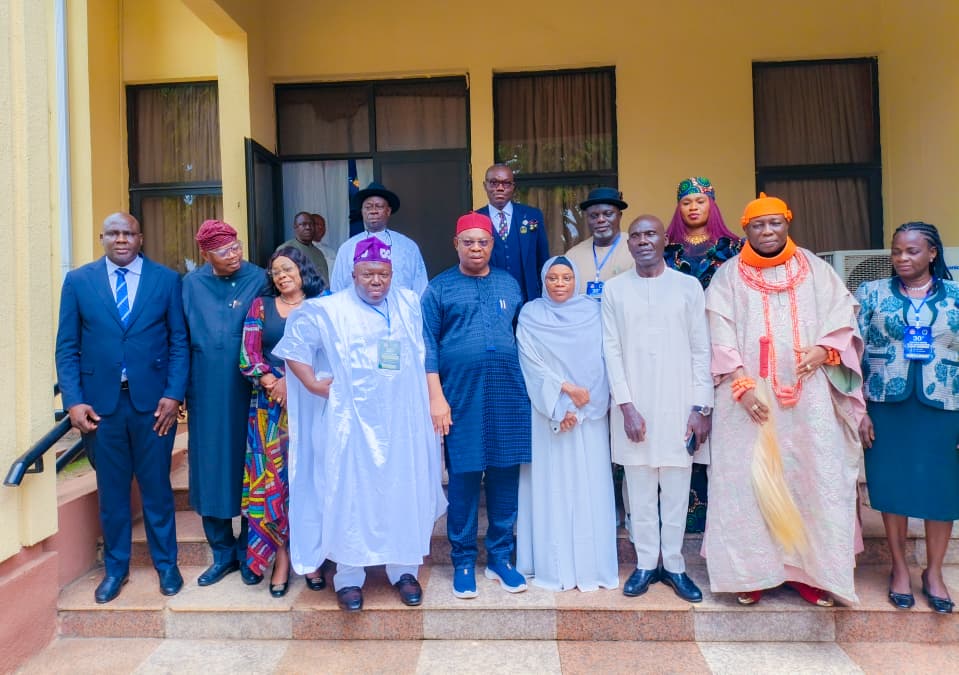
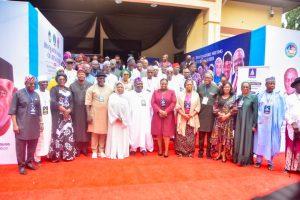
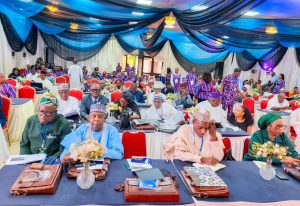
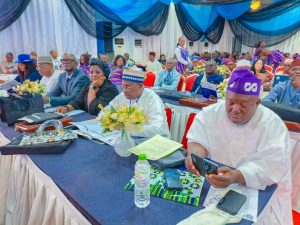
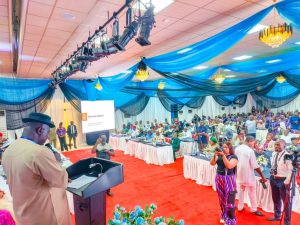
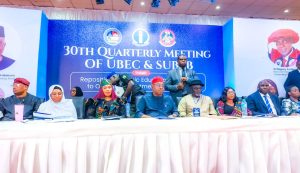
Basic Education stakeholders from across Nigeria converged in Asaba for the 30th Quarterly Meeting of the Management of the Universal Basic Education Commission (UBEC) with Executive Chairmen of State Universal Basic Education Boards (SUBEBs), to champion a new course for growth and development in the sector.
With the theme “Repositioning Basic Education in Nigeria to Optimize Investment and Impact”, the 4-day meeting is focused on converting investments into measurable learning outcomes and ensuring every Nigerian child has access to quality basic education.
Declaring the event open, Governor Sheriff Oborevwori, said education is central to his administration’s MORE Agenda, noting that the human impact of the meeting’s deliberations is already visible in Delta State.
Represented by the Deputy Governor, Sir Monday Onyeme, FCA, the Governor stated that in Delta’s public basic schools, more than 302,000 pupils are enrolled with over 187,000 learners representing 62% benefiting directly from interventions.
He said, “Working with D-SUBEB, the state has constructed 174 new classrooms, renovated 815, and is building 24 more. It has also built 39 perimeter fences and gatehouses, provided 230 VIP toilets, and installed 12 solar-powered boreholes to create safer and healthier learning environments. At the SMART School in Orogun, hostels, refectory blocks and staff quarters have been completed to support technology-driven learning”.
The Governor announced his earlier approval of the 2026 UBEC counterpart fund after fulfilling the 2025 obligation, noting that no investment is too great when it concerns the future of our children.
“The true measure of investment in education lies not in what we spend, but in the quality of learning we deliver, the opportunities we create, and the future we secure for our children,” Oborevwori said.
He commended UBEC for approving two additional Model Smart Schools for Delta, noting that government has provided the required land.
He also highlighted investments beyond SUBEB, including over 200 classrooms and 15,000 furniture units provided by the Ministries of Primary and Secondary Education, as well as new Government Technical Colleges with modern workshops to equip youth with practical skills.
On teachers, Oborevwori said over 5,500 teachers have been trained in Jolly Phonics, STEP, SMASE and School-Based Training, while 53 community tutors were deployed to underserved areas, disclosing that all 16 professional development programmes for 2026 have been implemented.
“To motivate teachers, the state approved career progression from Grade Level 14 to Grade Level 17. No education system can rise above the quality of its teachers. That is why teacher recruitment, welfare, motivation, and professional development remain priorities in Delta State,” the Governor concluded.
The Executive Secretary of UBEC, Dr. Aisha Garba, commended Delta for its hospitality and strategic investments, disclosing that states have now fully accessed over ₦177 billion in UBE Matching Grants.
She however drew attention to the fact that over ₦65 billion in counterpart funding and approximately ₦267 billion in previously released intervention funds remain unutilized.
“Accessing funds is only part of the responsibility before us. These resources cannot improve education while they remain in accounts” the Executive Secretary stated.
Dr. Garba said the scale of challenges requires states to look beyond traditional funding and strengthen partnerships with the private sector and development partners.
She announced the review of UBEC’s Ten-Year Strategic Roadmap to cover 2026-2035, the rollout of the Basic Education Action Plan Management System, BEAP-MS to digitize state planning, and the HOPE-EDU Operation supported by a World Bank loan of over US$500 million.
The UBEC Boss also highlighted the ‘Whole School Approach’ and the ‘National Learning Assessment’ conducted with the Federal Ministry of Education as tools for evidence-based interventions.
The host Chairman of SUBEB, Hon. Samuel Mariere, in his welcome address, said hosting the meeting demonstrates the importance attached to basic education in Delta State, expressing profound appreciation to UBEC for its partnership and to Governor Oborevwori for creating the enabling environment.
“These initiatives reflect a leadership philosophy in which investment in education is viewed not simply as expenditure, but as an investment in the future of Delta State. This is why we at D-SUBEB refer to His Excellency as the ‘Making a Difference Governor’,” he said.
Mariere commended the Governor’s vision for the deployment of SMART Board technology and digital monitoring systems to check teacher absenteeism in public basic schools.
“Technology can be deployed not merely as a learning tool but also as an instrument for improving accountability and institutional effectiveness” he noted.
The SUBEB Chairman also placed on record appreciation to the wife of the Governor, Mrs. Tobore Oborevwori, for her work with vulnerable children, saying “the success of an education system should not be measured only by what it provides for the majority, but also by the extent to which it reaches those who are most vulnerable”.
The Asagba of Asaba, His Royal Majesty, Obi Prof. Epiphany Azinge, SAN, OON, described education as the greatest investment any nation can make.
“The true wealth of Nigeria lies not beneath her soil but within the minds of her children. Oil may enrich a nation temporarily. Minerals may create wealth. Technology may accelerate growth. Yet, it is education that creates the human capital capable of discovering resources, developing technology, building institutions, and sustaining prosperity across generations,” the Asagba said.
The monarch outlined four pillars: Quality Teachers, Technology, Community Ownership, and Accountability, as ways to succeed.
He noted that his palace has transited from traditional rulership to traditional governance with school visits and provision of learning aids and furniture.
Obi Prof. Epiphany Azinge disclosed that the palace is building a SMART School to be donated to the Delta State Government upon completion, stressing that an education system is judged not by how well it serves the privileged but by how effectively it reaches the most vulnerable.
In other goodwill messages, stakeholders acknowledged the place of accountability and innovation in advancing inclusive and equitable education, and called for stronger collaboration among basic education stakeholders, including development partners and traditional rulers.
They stressed the need to speak frankly about the issues confronting the system, share what works, learn from one another and identify areas where stronger partnership can produce better results.
The speakers maintained that a strong and productive relationship between UBEC and SUBEBs is essential to achieve sustainable improvements.
The meeting continues with technical sessions on planning, resource utilization, digital transformation and strategies for expanding access to safe and inclusive basic education across the country.
There were cultural musical performances and other attractions during the opening session of the 4-day event.