
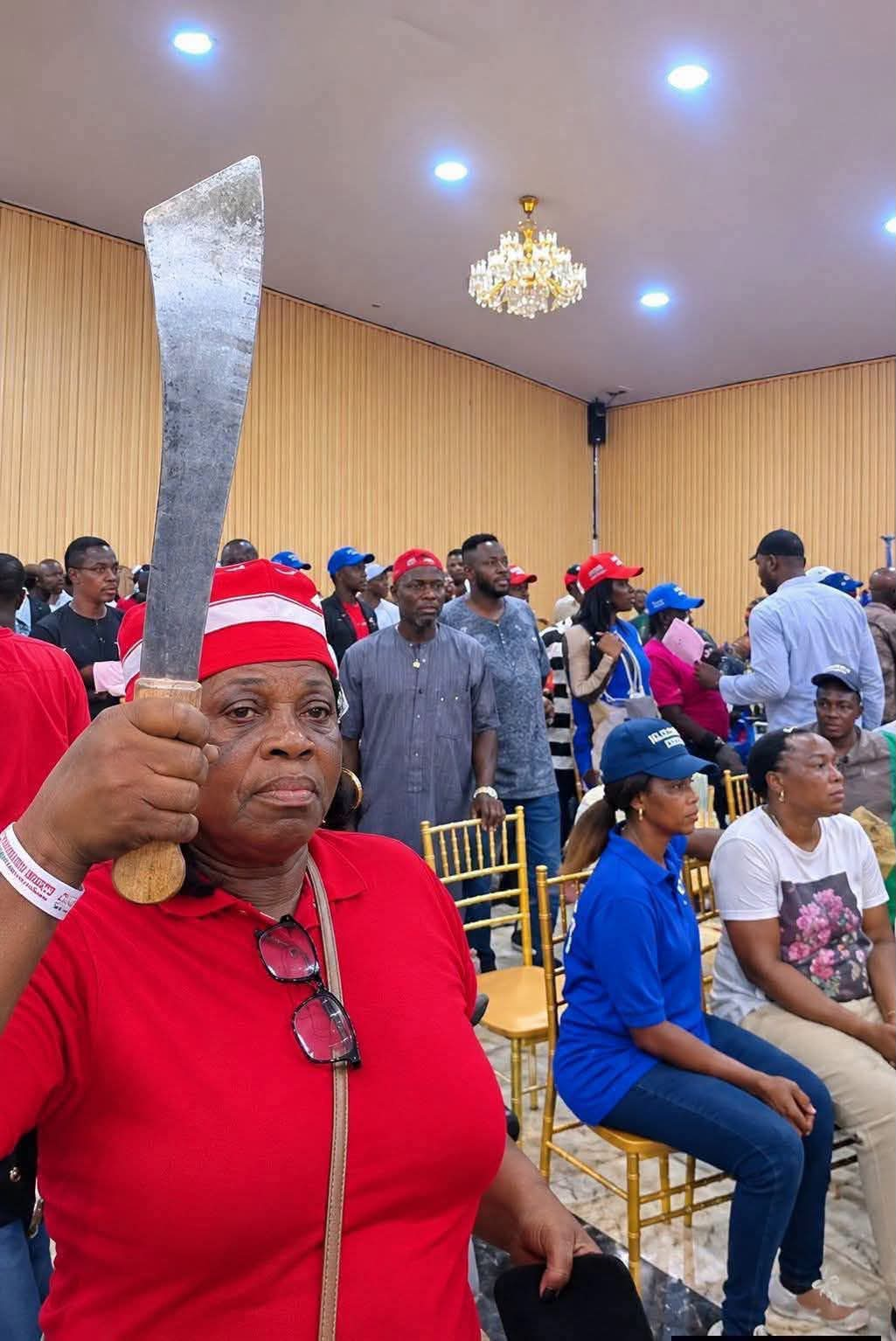
Members of the Delta Online Publishers Forum (DOPF) have expressed concern over the possibility of escalating political violence ahead of Nigeria’s 2027 general elections, following reports of an alleged attack on members of the Nigerian Democratic Convention (NDC) during a town hall meeting in Lagos.
The concerns followed the circulation of a viral video purportedly showing a woman wielding a cutlass after the alleged attack, reportedly involving suspected political thugs.
The footage sparked reactions on the Forum’s WhatsApp platform, with members expressing fears that growing political tension could undermine peaceful participation as the 2027 elections approach.
The Chairman of DOPF, Emmanuel Enebeli, warned that the coming election season could be challenging, particularly in January and February 2027.
“We are in for tough rides come January and February 2027,” he wrote.
His comments generated reactions from other members, including the Forum’s Vice Chairman, Chukwudi Abiandu, who expressed concern that the situation could degenerate into wider violence.
“Unfortunately, I hope it does not degenerate,” Abiandu stated.
Another member, Wilbert Ijeoma, compared what he described as the emerging confrontational disposition of supporters of Peter Obi, popularly known as Obidients, with the political movement associated with Rabiu Musa Kwankwaso.
”Obidients now have some touch of Kwankwassiya madness,” he remarked.
Celestine Ukah also suggested that the country’s political atmosphere could be approaching a period of heightened confrontation, noting that abnormal circumstances could provoke equally unusual reactions.
The Forum’s Secretary, Shedrack Onitsha, expressed the view that opposition supporters were increasingly prepared to resist political intimidation.
”It takes madness to cure madness! NDC members are fully prepared for APC thugs, sadly, NDC now has more deadly thugs than APC,” Onitsha stated.
However, his comments represented his personal assessment of the situation, as responsibility for the alleged attack had not been independently established.
In his contribution, Austin Azu criticised what he described as the silence of political leaders over attacks on opposition supporters, warning that failure to condemn political violence could encourage further intimidation.
He argued that political leaders had a responsibility to speak out against attacks, harassment and assaults, irrespective of the political affiliations of those affected.
Azu also called for stronger action by the Federal Government, including the investigation and prosecution of individuals responsible for political violence.
”This is not the democracy we fought for, nor the country we envisioned. I am deeply worried and emotional about the future of my generation, especially those who seem unconcerned about the dangers threatening the very democracy that should protect their future,” he said.
He further recalled the position repeatedly expressed by former President Goodluck Jonathan that no election was worth the life of any Nigerian.
Azu maintained that political ambition should not take precedence over human life, peace and democratic values.
The discussion also extended to the role of security agencies, with Abiandu criticising the Delta State Police Command over what he described as its handling of unfolding political developments.
He alleged that the command’s attitude raised questions about its commitment to addressing political intimidation, describing its response as disappointing.
However, the allegation was his personal assessment, and no evidence was presented during the discussion to establish police involvement in any political attack. The command’s response was also not available.
Amid the concerns, Azu posed a question about who would come to the aid of Nigerians amid the growing political uncertainty.
In response, Abiandu expressed confidence in divine intervention, citing biblical passages from Psalm 37:33 and Job 8:20.
He also drew a comparison with the military dictatorship of former Head of State, General Sani Abacha, recalling the atmosphere of fear and political repression during his administration.
Abiandu maintained that no political leader, regardless of power or influence, was beyond divine authority.
The conversation took another dimension when the Forum’s Treasurer, Joe Ogbodu, shared a separate video purportedly showing Nigerians confronting the Chairman of the Independent National Electoral Commission (INEC), Professor Joash Amupitan, during a visit to Chatham House in London.
The footage, which circulated online with claims that the INEC chairman had been disgraced, appeared to show aggrieved Nigerians demanding explanations over developments in the country.
A voice accompanying the video claimed that Nigerian youths had challenged the electoral chief to address their concerns.
However, the circumstances surrounding the encounter and the claims made in the circulating footage were not independently verified during the discussion.
Ogbodu’s contribution further highlighted concerns about public expectations of electoral transparency and accountability as the country prepares for another general election.
The exchanges among DOPF members reflect growing anxiety within sections of the media over the country’s political atmosphere and the potential consequences of confrontations between supporters of rival political parties.
Although members expressed different opinions about the unfolding developments, they agreed on the need for political actors, government authorities, electoral institutions and security agencies to protect citizens’ democratic rights.
The discussion also highlighted the distinction between peaceful political resistance and violence, stressing the importance of ensuring that political disagreements do not degenerate into attacks and intimidation.
As preparations for the 2027 general elections gather momentum, the concerns raised by the publishers underscore the responsibility of political parties and security institutions to guarantee a peaceful electoral environment.
Whether the fears expressed by the Forum’s chairman will materialise remains uncertain, but members say the protection of lives, democratic freedoms and peaceful political participation must remain a priority ahead of the polls.